The Next Decade of Placement – AI-Driven Process Control, Inline 3D Inspection Integration, and Autonomous SMT Lines
Published Time:
2026-04-14
The future of SMT assembly is shifting from reactive control to predictive and autonomous operation. By combining AI-driven process optimization, inline 3D inspection (SPI & AOI), and closed-loop control, modern pick-and-place lines can detect, predict, and correct issues in real time. This not only reduces defects and downtime but also enables the transition toward fully autonomous, “lights-out” SMT production.
The pick-and-place machine has evolved from a simple pick-and-place robot to a sophisticated data-generating platform. Yet, for the past decade, the core workflow has remained largely reactive: run a job, inspect a sample of boards after reflow, find defects, and adjust the line. This “measure-then-correct” approach leaves money on the table in the form of scrap, rework, and lost uptime. The next revolution in SMT assembly is predictive and autonomous. Enabled by artificial intelligence (AI), inline 3D inspection, and closed-loop process control, tomorrow’s pick-and-place lines will self-correct in real-time. A misplaced component will be detected and corrected before the next board is even processed. A feeder beginning to drift will be automatically recalibrated. This article explores the cutting-edge technologies that are transforming placement—AI-driven component tuning, integration with 3D solder paste inspection (SPI) and automated optical inspection (AOI), and the pathway to fully autonomous “lights-out” SMT lines.
Keywords: AI in SMT, closed-loop process control, inline 3D SPI, AOI integration, autonomous SMT line, predictive maintenance, self-correcting placement, machine learning, Industry 4.0, smart factory.
The Limitations of Traditional Process Control
Traditionally, SMT process control follows this sequence:
Stencil print solder paste.
Pick-and-place components.
Reflow solder.
Inspect after reflow (AOI).
If defects are found, an engineer guesses at the root cause (paste, placement, or reflow) and manually adjusts parameters.
This approach has three fatal flaws:
Latency: Defects are discovered after reflow, potentially hours after the root cause occurred. Hundreds of defective boards may be produced before correction.
Uncertainty: Without data from inside the placement machine, it is hard to distinguish placement errors from paste or reflow errors.
Subjectivity: Engineer “guessing” is not repeatable; different shifts may make different adjustments.
The solution is to close the loop: take real-time data from the pick-and-place machine and from upstream/downstream inspection systems, and use AI to make immediate, automated adjustments.
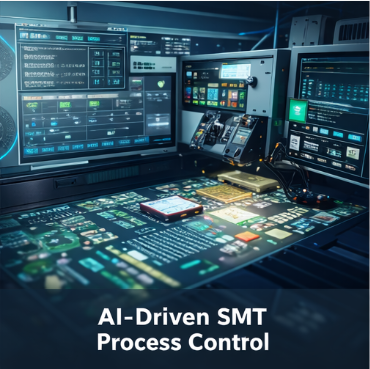
AI-Driven Placement Optimization
Modern pick-and-place machines generate enormous amounts of data per placement:
Pick vacuum level (nanoseconds of data).
Pick position offset (X, Y, Theta).
Component dimensions as measured by the vision system.
Placement force (Z-axis profile).
Board fiducial locations.
AI (specifically machine learning models) can analyze this data stream in real-time to detect anomalies that a human or simple threshold would miss.
Example 1: Component Tuning via Vision Data
For a fine-pitch QFN, the machine’s vision system captures the leads. A traditional system checks that all leads are present and co-planar within a fixed tolerance. An AI system goes further: it learns the “normal” shape of that component from the first 100 placements. If the 101st component has a lead that is slightly bent (but still within tolerance), the AI can predict that this bent lead will likely cause a solder bridge after reflow. The AI then does one of three things:
Reject the component (place it in a discard bin) and pick another.
Adjust placement (e.g., shift the component slightly to compensate for the bent lead).
Flag the component and alert upstream that the reel may have damage.
This predictive capability is impossible with rule-based vision systems.
Example 2: Feeder Drift Prediction
A mechanical feeder may develop wear over time, causing components to be presented at a slight rotation (e.g., 0.5 degrees). Individually, each placement might still be within spec. But the AI model, observing a gradual increase in average rotation over 1000 placements, can predict that the feeder will exceed spec in another 500 placements. It can then automatically:
Schedule maintenance for that feeder (send an alert to the operator).
Apply a compensating rotation offset in the placement program until maintenance is performed.
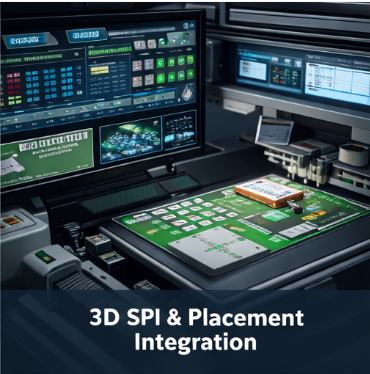
Inline 3D Inspection Integration (SPI → Placement → AOI)
The most powerful closed-loop application integrates the pick-and-place machine with upstream 3D solder paste inspection (SPI) and downstream 3D AOI.
Traditional (open loop):
SPI measures paste → placement ignores paste data → reflow → AOI finds defect → engineer tries to backtrack.
Closed loop with AI:
SPI measures each pad’s paste volume, height, and area. Data is sent to the placement machine.
Pick-and-place machine uses this data to adjust placement parameters per component:
If paste volume is low on a pad, the machine reduces placement force (to avoid squashing the insufficient paste).
If paste is misaligned on the pad, the machine shifts the component to align with the actual paste, not the pad copper.
After placement (before reflow), a 3D placement verification system (sometimes integrated into the placement head or a standalone inline station) measures component position and coplanarity.
If a placement error is detected (e.g., component is skewed), the machine can:
Immediately rework that board (remove component, clean pad, re-paste, re-place) before it goes to reflow.
Adjust the placement program for the next board.
After reflow, 3D AOI confirms final solder joint quality. Any remaining defects are fed back to the AI model to further refine placement parameters.
This closed-loop system can reduce placement-related defects by 80-90% compared to traditional open-loop lines. Several equipment vendors (including Mycronic, ASM, and Koh Young) now offer integrated SPI-to-placement closed-loop solutions.
Predictive Maintenance for Placement Machines
Unplanned downtime is the enemy of OEE. Predictive maintenance uses AI to analyze machine data and predict failures before they occur.
Sensors and data sources:
Vibration sensors on placement head gantries.
Motor current draw (linear motors).
Temperature sensors on critical bearings.
Vacuum pump runtime and pressure trends.
Example: A subtle increase in X-axis motor current over 2 weeks, combined with a specific vibration signature, might indicate a worn linear bearing. The AI model predicts bearing failure in 10 days with 90% confidence. The system automatically generates a work order and schedules maintenance for the next scheduled downtime (e.g., a weekend). The line never stops unexpectedly.
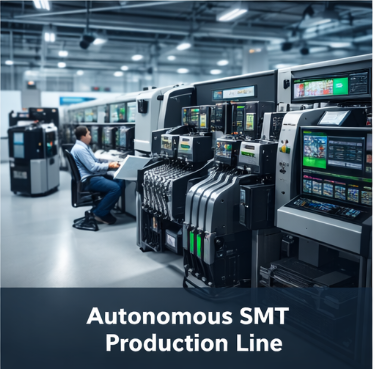
Autonomous (Lights-Out) SMT Lines
The ultimate expression of these technologies is the autonomous SMT line that runs 24/7 without human intervention. This is not science fiction; early adopters in high-volume consumer electronics and automotive are already running lights-out shifts.
Requirements for lights-out placement:
Bulk or extra-large reels: So that component replenishment is needed less than once per shift.
Automated feeder swapping: Robots or AGVs physically replace empty feeder carts with full ones.
Splice management: Machines must be able to detect and handle splices automatically (some smart feeders can “skip” a splice by advancing past it).
Self-cleaning nozzles: Nozzle cleaning stations built into the machine that automatically clean nozzles after a set number of picks.
Closed-loop process control: The line must be able to correct its own placement errors without human decision-making.
Remote monitoring: A “control tower” software (often cloud-based) allows a single operator to monitor 5-10 lines from a central location, intervening only when the AI cannot resolve an issue.
Benefits of lights-out SMT:
Utilization: Lines run 24/7, not just 2 shifts. Capital equipment is amortized faster.
Consistency: No shift-to-shift variation in setup quality or process decisions.
Labor cost: Operators are redeployed to higher-value tasks (process improvement, maintenance planning).
Current limitations: Lights-out is not yet feasible for high-mix lines with frequent changeovers or for lines handling extremely delicate components (e.g., some RF modules). However, for stable, high-volume products, it is already here.
Implementing AI and Closed-Loop: A Practical Roadmap
You do not need to buy a completely new line to benefit from these technologies. Many can be retrofitted.
Step 1: Data Integration (6-12 months)
Ensure your pick-and-place machines export placement data (pick offsets, vision results, force profiles) via standard protocols (IPC-CFX or Hermes).
Install a middleware platform (e.g., from a vendor like Valor or a custom solution) that collects data from SPI, placement, and AOI.
Step 2: Baseline and Visualization (3-6 months)
Use the data to create dashboards showing placement Cpk, feeder performance, and defect Pareto.
Identify the top 3 placement-related defect types.
Step 3: Closed-Loop for One Process (6 months)
Start with a simple loop: use SPI data to adjust placement force for large ICs. Measure defect reduction.
Step 4: AI Pilot (6-12 months)
Choose one use case (e.g., feeder drift prediction). Train an AI model on historical data.
Deploy in shadow mode (AI makes predictions but does not act). Validate accuracy.
Step 5: Autonomous Operation (Ongoing)
Gradually add more closed-loop and predictive use cases.
Invest in automation (feeder swapping, nozzle cleaning) as ROI justifies.
Conclusion
The pick-and-place machine is becoming a node in a connected, intelligent manufacturing ecosystem. AI-driven real-time process control, integration with 3D SPI and AOI, and predictive maintenance are not futuristic concepts—they are available today from major vendors and are being implemented by leading EMS providers and OEMs. The benefits are clear: dramatic reductions in placement defects, higher OEE, and the ability to run lights-out shifts. For electronics manufacturers, the question is no longer if to adopt these technologies, but how quickly they can integrate them into their existing lines. Start by auditing your data connectivity and picking one closed-loop use case. The journey to the autonomous SMT line begins with a single step—but it is a step that will define competitive advantage for the next decade.


No. 739, Zhou Shi Road, Hezhou Community, Hangcheng Street, Baoan District, Shenzhen



Copyright © 2025 Shenzhen ETON Automation Equipment Co., Ltd. ALL Rights Reserve.