Beyond the Basics – Advanced Feeder Technologies & Smart Line Optimization for High-Mix SMT Assembly
Published Time:
2026-04-13
In modern SMT manufacturing, the key challenge is no longer placement speed, but flexibility. With high-mix, low-to-medium volume (HMLV) production becoming standard, frequent changeovers and diverse components put pressure on efficiency and quality. The main bottleneck lies in feeder systems and line management, not the placement machine itself. By adopting advanced feeder technologies and smart line optimization strategies, manufacturers can significantly improve overall equipment effectiveness (OEE).
In the world of Surface-Mount Technology (SMT), the conversation often revolves around placement speed and head accuracy. However, for the majority of modern electronics manufacturers—especially those in contract manufacturing, automotive, and industrial sectors—the real challenge is not speed, but flexibility. High-mix, low-to-medium volume (HMLV) production has become the norm. This environment demands that pick-and-place lines change over quickly, handle an enormous variety of component sizes and packages, and maintain near-zero defect rates despite constant changeovers. The bottleneck in such lines is rarely the placement head; it is the feeder system and the intelligence of the line’s scheduling software. This article explores advanced feeder technologies (smart electronic feeders, bulk cassette feeders) and line optimization strategies (feeder setup optimization, component kitting, and real-time line balancing) that can dramatically improve overall equipment effectiveness (OEE) in high-mix environments.
The Reality of High-Mix Production
Traditional SMT lines were designed for high-volume, low-mix production—think thousands of identical smartphone motherboards per day. Changeover time (switching from one product to another) was negligible relative to run time. Today, a typical contract manufacturer might run 10-20 different PCBs per shift, with batch sizes as low as 50 units. In this scenario, changeover time directly eats into productive capacity. If it takes 45 minutes to swap feeders, load new programs, and verify first-article boards, a line running 2-hour batches is effectively idle for nearly 30% of the shift.
The pick-and-place machine itself is rarely the problem. Modern modular machines can store hundreds of feeder positions and switch programs in seconds. The real time sink is physical feeder handling: removing reels from the previous job, loading reels for the next job, threading tape through feeders, and verifying that the correct component is in the correct feeder lane. Advanced feeder technologies directly address this pain point.
Smart Electronic Feeders: The Core Enabler
Electronic feeders (also called motorized or intelligent feeders) have transformed high-mix SMT. Unlike mechanical feeders, which rely on the machine’s head to mechanically index the tape, electronic feeders have their own precision motor, controller, and often onboard memory.
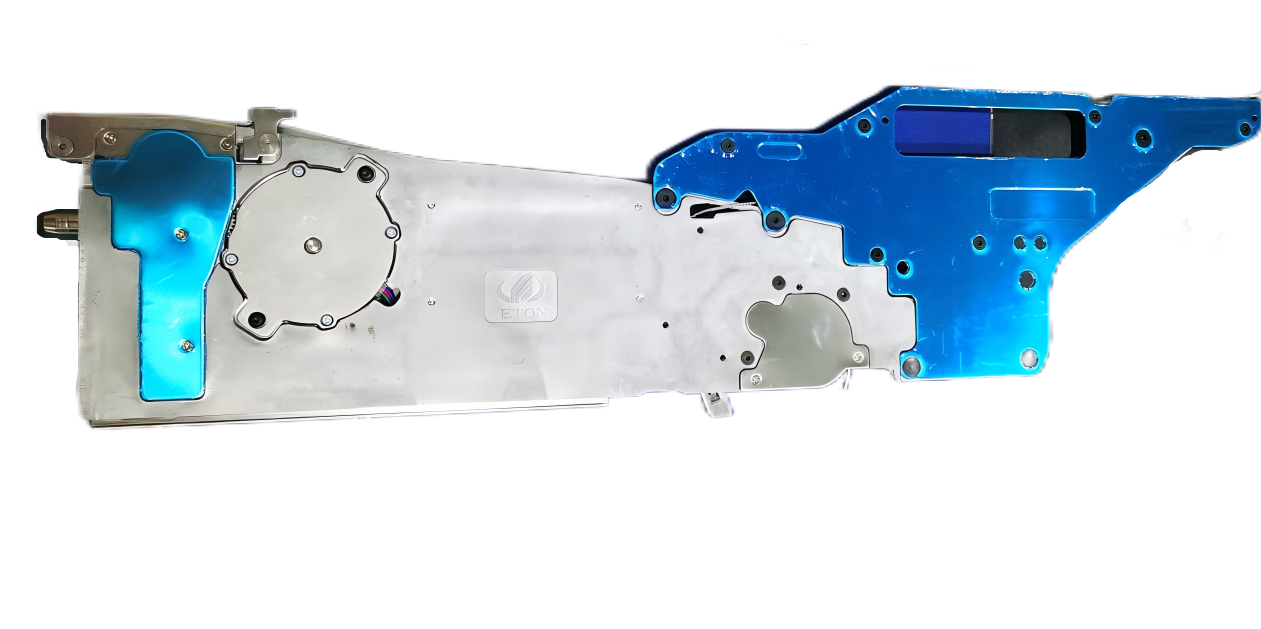
Key capabilities of smart electronic feeders:
Independent Indexing: The feeder can advance tape at optimal speed, separate from the head’s motion. This allows the head to move continuously while the feeder prepares the next component—eliminating wait time.
Splice and End Detection: Smart feeders use optical sensors to detect the tape splice (where two reels are joined) or the end of the tape. When the end is near, the feeder sends an alert to the line controller, which can automatically schedule a replenishment.
RFID and Data Storage: Each feeder can store its own calibration data, component ID, quantity remaining, and even lot traceability information. When mounted on the machine, the feeder identifies itself, and the machine verifies that the correct component is loaded for the current job. This prevents costly wrong-component placements.
Peel Force Monitoring: Some advanced feeders measure the force required to peel the cover tape. If the force exceeds a preset threshold (indicating a potential “popcorn” ejection of components), the feeder slows down or alerts an operator.
Bulk Feeders: A Game-Changer for Passives
For chip components (resistors, capacitors, inductors), tape-and-reel is the standard but creates massive waste and changeover overhead. A single 7-inch reel of 01005 resistors holds only 15,000 pieces—enough for perhaps 20 boards in a dense design. In high-mix, operators spend an inordinate amount of time swapping small reels.
Bulk feeders (also called bulk component feeders or cassette feeders) offer an alternative. Components are supplied in a hopper or cartridge, and the feeder uses vibration or a rotating brush to orient and present them one by one.
Advantages of bulk feeding for high-mix:
Reduced reel changes: A bulk cartridge can hold 50,000-200,000 components, lasting through many job changeovers.
No tape waste: Eliminates cover tape and carrier tape disposal.
Smaller footprint: A bulk feeder occupies about the same space as two tape feeders but holds far more components.
Challenges: Bulk feeders are less precise than tape feeders for very small components (01005 and below) and offer no individual component traceability. They are best suited for non-critical passives where reel-level traceability is not required.
Line Optimization Strategies for High-Mix
Technology alone is not enough. How you organize your line and schedule jobs is equally important.

1. Feeder Setup Optimization (aka “Feeder Kitting” or “Feeder Trolley Strategy”)
The goal is to minimize the number of feeders that must be physically swapped between jobs. This is achieved by:
Dedicated feeders: Assign specific feeders to components that appear on many different board types (e.g., 10kΩ resistor, 0.1µF capacitor). These feeders remain on the machine permanently, parked in a “common” zone.
Job-specific “kits”: For components unique to a particular product, pre-load them onto a separate feeder trolley (cart) offline. When the job starts, roll off the previous trolley and roll on the new one. Changeover time drops from 45 minutes to under 5 minutes.
Software optimization: Advanced SMT scheduling software (e.g., from ASM, Fuji, or Universal Instruments) can analyze a week’s production schedule and suggest the optimal assignment of components to feeders to maximize commonality across jobs.
2. Component Kitting (Offline Preparation)
The act of loading reels onto feeders is a non-value-added activity when done on the machine. Move it offline to a dedicated “feeder setup station.” Here, operators can:
Load reels onto feeders.
Scan reel barcodes and feeder RFID tags to link them in the software.
Verify correct component orientation.
Store the loaded feeders on a rack or cart, ready for the next job.

3. Dynamic Line Balancing
In a multi-machine line (e.g., a high-speed chip shooter followed by a flexible fine-pitch placer), the total line speed is limited by the slowest machine. Dynamic line balancing software monitors the placement time for each machine in real-time and can dynamically shift component assignments between machines if one falls behind. For example, if the chip shooter finishes its 2,000 placements while the fine-pitch machine still has 500 placements left, the software can reassign some of the fine-pitch components to the chip shooter for the next board. This requires compatible machines and a central line controller.
4. Real-Time Feeder Replenishment Alerts
Nothing kills OEE like a line stoppage for an empty feeder. Smart feeders with end-of-tape detection can send alerts to a central dashboard or even to an operator’s wearable device (smartwatch, headset). The operator retrieves the next reel, splices it onto the tail of the old reel (using a splice tab), and the line never stops. Some advanced lines use automated guided vehicles (AGVs) to deliver reels to the feeder.

Measuring Success: OEE and Changeover Time
Track these metrics to quantify improvement:
Changeover Time (C/O): Time from the last good board of job A to the first good board of job B. With smart feeders and trolleys, aim for <10 minutes. World-class lines achieve <5 minutes.
Feeder Setup Accuracy Rate: Percentage of times the correct component is loaded in the correct feeder lane. Goal: 100% (any error leads to defective boards).
Placement OEE: Overall Equipment Effectiveness = Availability × Performance × Quality. In high-mix, availability is dominated by changeover and feeder-related stops. Target OEE >75% for high-mix lines (compared to >85% for high-volume).
Case Study: Automotive EMS Provider
A mid-sized electronics manufacturing service (EMS) provider producing 50 different automotive PCBAs per week (batch sizes 100-500) faced changeover times of 90 minutes per job. They operated 4 lines, each with 120 feeder lanes.
Actions taken:
Upgraded 80% of feeders to smart electronic feeders with RFID.
Purchased two offline feeder setup stations and 8 spare feeder trolleys.
Implemented feeder kitting software to optimize commonality.
Results after 6 months:
Average changeover time: 90 min → 12 min.
Feeder-related placement defects: reduced by 65% (RFID verification eliminated wrong-component errors).
Line utilization (OEE): 42% → 78%.
The company avoided purchasing a fifth line because existing lines now had enough capacity.
Future: Automated Feeder Swapping
The next frontier is fully automated feeder exchange. Some new machines (e.g., from Fuji and Yamaha) offer robotic arms that physically remove feeder carts and replace them with new ones. Combined with AGVs that deliver carts from a warehouse, this enables “lights-out” high-mix production—running batches of different products overnight without human intervention.
Conclusion
For the majority of SMT lines today, the limiting factor is not the speed of the placement head but the efficiency of the feeder system and changeover process. By investing in smart electronic feeders, bulk feeders for passives, and adopting disciplined offline kitting and line balancing software, manufacturers can slash changeover times from hours to minutes. This unlocks the ability to profitably run very small batches—a competitive necessity in the era of mass customization and just-in-time inventory. If your SMT line struggles with high-mix, stop looking at placement speed and start auditing your feeder management and changeover workflow. The gains are often immediate and substantial.


No. 739, Zhou Shi Road, Hezhou Community, Hangcheng Street, Baoan District, Shenzhen



Copyright © 2025 Shenzhen ETON Automation Equipment Co., Ltd. ALL Rights Reserve.