How will the LED industry develop in five provinces and cities in China in the future?
Published Time:
2021-08-04
There used to be a saying: "China's LED industry is in Guangdong." In fact, looking at Shenzhen alone, this city, which boasts the nation's largest cluster of publicly listed LED companies, is clearly not exaggerating.
There used to be a saying: "For China's LED industry, look to Guangdong." In fact, looking at Shenzhen alone, this city, home to the country's largest cluster of listed LED companies, is clearly not overstated.
However, from a national perspective, several regions that have deployed LED industries, including Nanchang, Yiwu, and Xiamen, and even Shandong Province, which considers itself a "latecomer," are continuously increasing their development efforts... So, what is the development status and future plans of these provinces and cities?
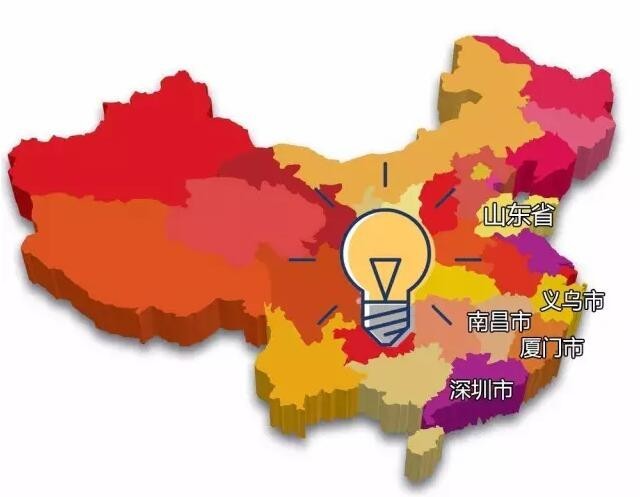
1. Shenzhen: Production capacity is being transferred, conditions for industrial spillover are present
Shenzhen's LED industry is synonymous with China's LED industry. It possesses a complete industrial chain, the country's largest LED packaging and display screen production base, and the nation's largest cluster of listed LED companies. According to incomplete statistics, Shenzhen currently has nearly 2,300 semiconductor lighting-related enterprises, accounting for half of Guangdong Province and one-third of the national industry. These are mainly concentrated in four districts: Bao'an, Longhua, Guangming, and Longgang, with over 800 in Bao'an District. In 2016, the city's LED output value exceeded 170 billion yuan, ranking first nationwide. This output value was only 18 billion yuan a decade ago. In the same period last year, the national LED output value was 521.6 billion yuan, with Shenzhen accounting for nearly one-third.
From the perspective of Shenzhen's LED industry structure, most companies are concentrated in the lower reaches of the LED industry with lower barriers to entry. Relatively homogenous competition has also caused the industry to repeatedly experience "shocks" due to supply and demand imbalances. Influenced by factors such as land resources, factor costs, and supporting policies, Shenzhen's LED industry is experiencing a transfer of production capacity. However, Shenzhen's advantages in innovation and talent ensure that the city remains the center of the national LED industry. It is indicated that after several years of market adjustment, the future will be more stable. The way out for enterprises still lies in continuous innovation to escape homogenous competition. At the same time, Shenzhen has the conditions for the spillover of the LED industry. As a national innovation city, Shenzhen seeks to improve per capita GDP. In the future, Shenzhen should become the headquarters and R&D base for the LED industry.
2. Nanchang: Using LED as a driving force to form an electronic information industry cluster
The 2017 government work report mentioned the goal of building Nanchang into a nationally influential LED industrial base. Currently, Jingneng Optoelectronics is the third company globally and the only company in China with original intellectual property rights in LEDs. Leveraging this technological advantage, Nanchang City aims to develop Nanchang Guanggu (Nanchang Optics Valley) and accelerate the formation of an electronic information industry cluster in Nanchang, driven by LEDs. At the beginning of this year, the Nanchang Municipal Party Committee and Municipal Government established the strategy of "strongly attacking industries and decisively engaging in industrial development," prioritizing attracting investment and undertaking industrial transfer as the "number one project." The Nanchang government believes that promoting this transfer is not a simple relocation of industries, but simultaneously accomplishing industrial upgrading and aggregation. Nanchang's undertaking of industrial transfer is to combine the transfer with supply-side structural reforms, industrial transformation, and upgrading, actively encouraging enterprises in developed eastern regions to transfer advanced technologies, the latest products, and industry formats.
According to reports, Jiangxi Hongli Optoelectronics Co., Ltd., located in the Nanchang Economic and Technological Development Zone, is the only production base of Hongli Zhihui Group outside of Guangzhou. The project has a total investment of nearly 1.5 billion yuan and will build a large-scale domestic LED mid- and downstream supply industry park. Phase one of the project began construction in August 2015, went into production in August of last year, and is expected to achieve sales of 1 billion yuan this year. Currently, Nanchang's electronic information industry has formed two complete industrial chains: LED and mobile communication terminals. In the LED industry, a complete industrial chain has been formed, including core materials, core equipment, upstream chips, midstream packaging, and downstream application products. By 2020, Nanchang's LED industry scale will reach 50 billion yuan. In the mobile communication terminal industry, over 90% of mobile phone components can be sourced locally, making it an important mobile phone production base in China. In 2016, the city's electronic information industry experienced explosive growth, with a total of 59.79 billion yuan in main business income, a year-on-year increase of 50.1%.
3. Yiwu: 20 billion yuan in investment in one year, building a new LED industrial zone
Today, Yiwu, known as the "World Supermarket," has a new calling card—the Light Source Technology Town. Located in the northeast of Yiwu within the provincial information and optoelectronic high-tech park, the town focuses on the development of the semiconductor optoelectronic industry, supplemented by smart home and Internet of Things device research and development and manufacturing, while also incorporating leisure tourism functions. It aims to become a center for the global LED industry. It is reported that driven by Huacan Optoelectronics, Ruifeng Optoelectronics, and Mulinsen, the three leading companies, the Light Source Technology Town is already taking shape. City leaders have stated that the Light Source Technology Town will form an industrial cluster with an output value exceeding 100 billion yuan and will become a domestic and even international LED industry center within a few years, greatly promoting the process of integration between industry and city.
According to reports, several major projects of the three leading LED companies, Huacan Optoelectronics, Ruifeng Optoelectronics, and Mulinsen, have settled in Yiwu, with a total investment of approximately 20 billion yuan. The Huacan Optoelectronics Yiwu LED project fills the gap in the upstream of Zhejiang Province's LED industry chain. The project officially started construction on May 31 last year and is now in the final stages of production. In addition to the Huacan Optoelectronics project in the provincial information and optoelectronic high-tech park, the Ruifeng Optoelectronics Yiwu LED project, with a total investment of 2 billion yuan, mainly builds a production and manufacturing base for LED packaging and testing and a domestically advanced new energy project. The project is divided into two phases, with the first phase covering 100 mu (approximately 6.7 hectares). At the same time, the Mulinsen LED project in the high-tech zone, with a total investment of 5.5 billion yuan, covers an area of 600 mu (approximately 40 hectares).
4. Xiamen: Promoting the aggregation of the LED industry and clarifying the direction of innovative development
As a special economic zone, Xiamen has always been an important base for the development of China's LED industry, especially in LED exports. In 2016, Xiamen ranked 13th in the national urban innovation index and 16th in the regional comprehensive innovation index. Xiamen's leading comprehensive scientific and technological innovation capabilities are also reflected in the innovation of the optoelectronic industry. Last year, Xiamen's optoelectronic enterprises accelerated their independent innovation capabilities, producing a series of world-class products and technologies, including China's first flexible AMOLED display screen and single-layer graphene. Today, the Xiamen region brings together many well-known enterprises across the entire industry chain, including Xiamen San'an, Xiamen Xinda, Qianzhao Optoelectronics, and Tongshida Lighting. Among the representative enterprises, San'an Optoelectronics' low- and medium-power chip products have achieved internationally leading levels in brightness and stability. At the same time, San'an Optoelectronics has also invested in the research and development and manufacturing of third-generation semiconductors represented by gallium nitride, filling a gap in China's manufacturing sector.
Relevant statistics show that the Xiamen LED industrial base has 28 national, provincial, and municipal enterprise technology centers, 9 national, provincial, and municipal key laboratories, 8 national-level postdoctoral workstations, 8 national, provincial, and municipal engineering technology research centers, and the country's first professional testing institution for LED application products—the National Semiconductor Light Emitting Device (LED) Application Product Quality Supervision and Inspection Center. It is analyzed that during the "Thirteenth Five-Year Plan" period, the Xiamen LED industrial chain is expected to exceed 100 billion yuan in scale. Xiamen's "Thirteenth Five-Year Plan" also points out that it will improve the development level of the optoelectronic lighting industry, deepen and extend the LED and other energy-saving lighting industry chains, and expand high-end sections of the value chain. It will fully leverage the leading position of the "National Semiconductor Lighting Engineering Industrialization Base" to promote the clustered development of the LED industry. At the same time, it will clarify the direction of industrial innovation development, vigorously developing LED epitaxial wafer substrate materials, new packaging technologies and processes, high-end lamps and intelligent lighting systems, and applications in special LED fields (such as agricultural lighting, forestry lighting, and medical lighting).
5. Shandong: Catching up quickly, increasing the promotion of high-efficiency LED lighting products
Previously, at an energy-saving conference held in Shandong Province, a key point was identified: the task of energy saving and consumption reduction during the period of economic adjustment continues to increase. For lighting sources, which are major energy consumers, the promotion of energy-efficient LED lighting products in major lighting energy consumption areas should be increased. Data shows that the demand for LED products in the Shandong market can account for 8%-10% of the national total demand, making it the second largest market in the country. However, at present, the vast majority of LED products used in Shandong come from outside provinces such as Guangdong, and the market share of local enterprises is negligible. It is understood that Shandong Province was the first to overcome technical difficulties in the field of commercial LED lighting, and the world's first road using LED lighting, Weifang Beihai Road, was born there. Although it was among the earliest to adopt LED lighting in public works and commercial applications, its early advantage failed to translate into market dominance.
Analysis indicates that this is related to the weak expansion capabilities of enterprises and the relatively conservative government promotion efforts. However, Shandong has a strong economic foundation and a large population, and its efforts in energy saving and consumption reduction have always been considerable. In the next three to five years, the industry generally believes that this region will be a major consumption center for LEDs. It is reported that this year, Shandong Province will increase the promotion of energy-efficient LED lighting products in key lighting energy consumption areas. In order to support local enterprises, the Provincial Department of Economy and Information Technology, together with the Provincial Department of Finance, the Provincial Department of Housing and Urban-Rural Development, and the Provincial Department of Transportation, formulated the "Shandong Provincial Action Plan for the Promotion of Energy-Efficient Semiconductor Lighting Products." In addition, in the first half of this year, the Provincial Department of Economy and Information Technology will work with relevant provincial departments to increase promotion efforts and assist enterprises in establishing industry alliances.

No. 739, Zhou Shi Road, Hezhou Community, Hangcheng Street, Baoan District, Shenzhen


Copyright © 2025 Shenzhen ETON Automation Equipment Co., Ltd. ALL Rights Reserve.